
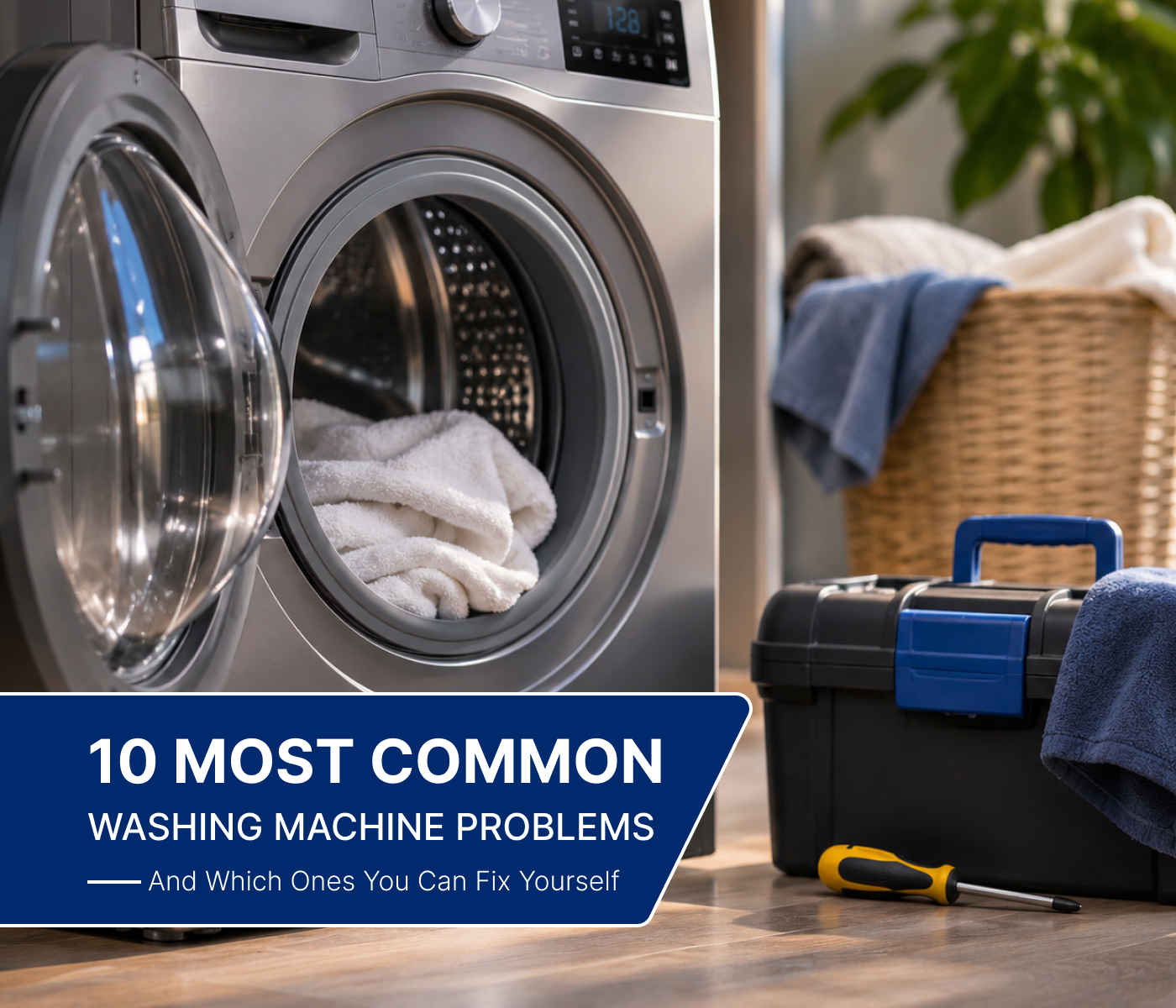
10 Most Common Washing Machine Problems
Quick answer:
The most common washing machine problem is not draining, and it's usually a sock, a hair tie or lint stuck in the drain filter or pump. The rest of the top ten are: won't spin, shaking or walking, leaking, won't start, door won't lock or unlock, not filling (or filling and draining at the same time), bad smell, loud noise, and error codes. About half can be fixed at home in under 30 minutes. Door locks, inlet valves, pumps, bearings and control boards usually need a technician.
Washers rarely die without warning. First it drains a little slowly, or it thumps during spin, or the towels come out smelling like a basement. Those warnings point to a short list of usual suspects.
The list below is roughly in the order we see these problems on service calls around Charlotte.
At a glance
# | Problem | Most common cause | DIY or pro? |
1 | Won't drain | Clogged drain filter or blocked pump | DIY first |
2 | Won't spin | Water still in the tub, unbalanced load, lid or door lock | DIY first |
3 | Shaking or walking | Uneven load, washer not level, shipping bolts, worn suspension | DIY first, pro for suspension |
4 | Leaking | Hose connection, door boot, pump seal | Depends on where |
5 | Won't start | Door lock, power, control lock, control board | DIY checks, then pro |
6 | Door won't lock or unlock | Water still inside, or a failed lock | DIY check, then pro |
7 | Not filling, or filling and draining at once | Closed taps, clogged screens, inlet valve, siphoning drain hose | DIY checks, then pro |
8 | Bad smell | Mold in the door boot, too much detergent, dirty drain filter | DIY |
9 | Loud noise | Coins or debris, worn bearings, pump | Depends |
10 | Error codes | Varies by brand | Look up the code, then decide |
Larger datasets show the same pattern. Yale Appliance, which handles more than 33,000 service calls a year, lists not draining, clothes still wet after the cycle, noise from foreign objects, door and lid lock problems, and oversudsing from too much detergent among the top reasons washers need service.
1. Won't drain
This is the call we get most. Water sits in the drum at the end of the cycle, and the washer may show an error code (OE on LG, SE or 5E on Samsung).
Usual causes: a sock, baby clothes, pet hair, coins or a hair tie in the drain filter or pump, a kinked drain hose, or a pump that has failed.
DIY: On most front-loaders, the drain filter sits behind a small panel at the bottom front. Lay down towels and put a shallow pan in front of it, because a lot of water comes out. Unscrew the filter slowly, clear it, then check the drain hose behind the washer for kinks.
Call a pro: If the pump hums but nothing drains after the filter is clean, or if you hear nothing at all. Another case to watch for: the washer drains fine but still shows the error. Techs on r/appliancerepair point out that the culprit is often the pressure sensor or its small air hose, which tells the washer how much water is in the tub, not the pump.
Step-by-step: washing machine not draining. Brand-specific: LG washer OE code and Samsung washer SE code.
2. Won't spin
Many "won't spin" washers are really drain problems. The washer won't spin while there's still water in the tub. The other common cause is a load it can't balance, like one wet comforter stuck to one side.
DIY: Redistribute the load, run a drain-and-spin cycle and clean the drain filter.
Call a pro: If it won't spin even when it's empty. That points to a lid switch, door lock, belt, motor or control problem.
Step-by-step: washing machine won't spin.
3. Shaking, banging or walking across the floor
Usual causes: one heavy item bunched to one side, a washer that isn't level, shipping bolts still in a new washer, or worn suspension rods or shocks.
DIY: Rebalance the load, wash bulky items with a few towels, and level the feet with a bubble level. Lock the feet in place with their nuts.
If the washer is new, check for shipping bolts first. Front-loaders ship with bolts in the back that lock the drum in place. If they're left in, the drum can't pass vibration to its dampers and the whole machine shakes, sometimes hard enough to move across the floor.
Call a pro: If an empty washer still bangs during spin. That means the suspension is worn.
Brand-specific: LG washer UE code.
4. Leaking
Where the water shows up tells you where to look:
Behind the washer: inlet hose connections or a split fill hose
In front, under the door: a torn or dirty door boot (front-loaders)
Underneath: the drain pump seal, tub seal or an internal hose
Only on some cycles, with lots of suds: too much detergent or the wrong kind
Why it's worth taking seriously: Supply hose failures are one of the most expensive problems a washer can have. The Insurance Institute for Business & Home Safety (IBHS) reports that washing machine failures cost an average of about $5,300 per claim after the deductible, and that faulty supply hoses cause more than half of them. State Farm says it paid nearly $30 million in 2020 for washer hose failures, with an average claim of $10,200. A burst hose can release around 650 gallons of water an hour.
DIY: Tighten hose connections and replace rubber fill hoses with braided stainless steel ones. Many manufacturers recommend new hoses every 5 years. Wipe debris off the door boot.
Call a pro: For leaks from underneath or a torn door boot.
Step-by-step: washer leaking water.
5. Won't start
DIY checks:
Is it plugged in, and has the breaker or GFCI outlet tripped?
Is the child lock or control lock on? (On many models you hold a button for 3 seconds to turn it off. Check your manual.)
Is the door or lid fully closed?
Is a delay-start timer set?
Call a pro: If the display lights up but nothing happens, or the washer is completely dead even though the outlet works. The usual causes are a door lock, lid switch or control board.
6. Door won't lock or unlock
Front-loaders won't start until the door locks, and won't open until the drum is empty and the lock releases. A failed lock assembly is one of the most common front-loader parts we replace. Yale notes that forcing the door is a common reason these locks break.
DIY: If the door won't open, the washer may still think there's water inside. Clean the drain filter, then wait 2 to 3 minutes after the cycle ends. Don't force it.
Call a pro: If the lock clicks but never catches, or the error code points at the lock.
7. Not filling, or filling and draining at the same time
DIY: Make sure both taps behind the washer are fully open. Turn the water off, unscrew the inlet hoses at the washer, and clean the small mesh screens inside the inlet ports.
Check the drain hose too. If the washer seems to fill forever, or you hear it draining while it fills, the drain hose may be pushed too far down the standpipe. That creates a siphon that pulls water out as fast as it comes in. Techs on r/appliancerepair see this constantly. Manufacturers set clear limits: Whirlpool and Maytag say no more than 4.5 inches of hose in the standpipe, GE says 5, and LG says 8. Never tape the hose to the pipe; there has to be an air gap. For reference, the International Residential Code requires a standpipe to rise 18 to 42 inches above its trap.
Call a pro: If pressure is good, the screens are clean and the hose is set right, the water inlet valve has probably failed.
8. Bad smell
A musty smell is mold and detergent residue, mostly in the front-loader door boot, the dispenser drawer and the drain filter. A sewage smell usually means a dirty drain filter or a drain problem, not mold.
What works, according to the people who fix these machines:
Use much less HE detergent than you think. Front-loaders use very little water, and the extra soap doesn't rinse out.
Wipe out the folds of the door boot every week or two.
Pull and rinse the dispenser drawer.
Run a hot cleaning cycle with a washer cleaner about once a month. Many front-loaders show a tub-clean reminder every 30 to 40 washes.
Leave the door cracked an inch or two between loads so the drum can dry. It doesn't need to stand wide open.
Clean the drain filter. It collects gunk that smells.
9. Loud grinding, roaring or rattling
Sound | Likely cause | DIY or pro? |
Rattling or clicking | A coin, key or bra wire in the drum or pump | Often DIY |
Roaring during spin that gets louder over weeks | Worn tub bearings | Pro; on older washers often a repair-or-replace call |
Humming but not draining | Blocked or failing drain pump | Clean the filter first, then pro |
Squealing (belt-drive models) | Worn belt or motor pulley | Pro |
Loud bang plus a wobbling drum (older front-loaders) | Cracked spider arm | Pro; often not worth repairing on an older washer |
10. Error codes
Modern washers tell you a lot through codes, but every brand uses its own. Start with our washer error codes explained guide, or go straight to a brand guide like the LG UE code. Shopping for a new one? See our LG vs Samsung washer reliability comparison.
Is it worth repairing a washing machine?
Usually. The National Association of Home Builders puts the average washer's life at about 10 years, and national cost guides put most washer repairs at $125 to $450. A rule of thumb many repair techs use: if the repair costs half or more of a comparable new washer, replace it.
Washer age | Repair needed | What we'd usually do |
Under 7 to 8 years | Pump, lock, valve, boot, switch, belt | Repair |
7 to 10 years | A common part | Usually repair |
Over 10 years | Bearings, drum support, motor, main control board | Get a quote and compare it to replacement |
Any age | Different parts failing one after another | Start budgeting for a new one |
For local numbers, see our Samsung washer repair cost guide and appliance repair costs in Charlotte.
Five habits that prevent most of this
Clean the drain filter every 2 to 3 months on a front-loader.
Measure HE detergent. Oversudsing causes drain errors, odors and slow spins.
Check pockets for coins, keys, hair ties and tissues.
Crack the door after the last load so the drum dries out.
Look at the fill hoses twice a year, and switch rubber hoses to braided stainless steel.
Frequently Asked Questions
What is the most common fault on a washing machine?
Not draining is the most common washing machine fault. It's usually caused by a clogged drain filter, a blocked pump or a kinked drain hose, and it can often be fixed at home by cleaning the filter.
Why does my washer keep filling and draining at the same time?
The drain hose is probably pushed too far into the standpipe, which creates a siphon that pulls water out as the washer fills. Pull the hose up so only a few inches sit inside the pipe (Whirlpool says 4.5 inches, GE 5, LG 8) and leave an air gap around it.
Why does my new washer shake so much?
The most common reason is that the shipping bolts weren't removed from the back of the washer. On many models, each bolt also has a plastic or rubber spacer that has to come out. An unbalanced load or a washer that isn't level can also cause heavy shaking.
How do I stop my front-load washer from smelling?
Use less HE detergent, wipe the door boot regularly, clean the dispenser drawer and drain filter, run a monthly hot cleaning cycle, and leave the door slightly open between loads so the drum can dry.
How often should I replace washing machine hoses?
Many manufacturers recommend replacing washing machine hoses every 5 years. Braided stainless steel hoses are a good upgrade, since hose failures are a leading cause of washer water damage claims.
Is it worth repairing a 10-year-old washer?
It depends on the repair. A pump, lock or valve is often worth fixing. If the repair costs half or more of a comparable new washer, which is common with bearings, drum supports or main control boards, replacement usually makes more sense.
The bottom line
Most washer problems come down to a short list: drainage, balance, leaks, locks and valves. Many start with something simple, like a sock in the filter or a drain hose pushed too far down the pipe. Try the DIY checks first. If the problem comes back, or the washer stays stuck, it's time for a diagnosis.
FM Appliances repairs all major washer brands in Charlotte and the surrounding cities. Learn more about our washing machine repair service, see washer repair in Charlotte, or contact us to book a visit.
About FM Appliances
FM Appliances is a local appliance repair company serving Charlotte, NC and nearby cities in North and South Carolina, including Matthews, Concord, Monroe, Waxhaw, Fort Mill, Rock Hill and Lancaster. Our technicians repair washers, dryers, refrigerators, dishwashers, ovens, cooktops, microwaves and range hoods from brands including LG, Samsung, Bosch, GE, Whirlpool, Sub-Zero and Wolf. This guide draws on our own service calls, technician discussions on public repair forums, and the sources listed below.