


Ice Maker Not Working? Here's How to Diagnose and Fix It
You go for a glass of ice and the bin is empty again. Maybe the arm is cycling but nothing drops, maybe the cubes come out hollow and half-frozen, or maybe the whole unit has gone dead quiet. A refrigerator ice maker not working is one of the most common repair calls we run in Charlotte, and the good news is that a fair number of these problems have a fix you can handle yourself in twenty minutes. Let's find out which kind you've got.
Key Takeaways
If your ice maker is not working, the cause is usually simple — and often something you can sort out yourself before anyone comes over. This guide walks through the seven most common reasons an ice maker quits, roughly in the order a technician checks them: a freezer that's too warm, a switched-off arm, a frozen water fill tube, a clogged filter, a stuck water inlet valve, low household water pressure, and a worn-out ice maker module. Along the way it covers the quick DIY fixes (thawing the fill tube, changing the filter, running a reset), the Charlotte-specific hard-water problems that make filters and valves clog sooner here, and the clear line where a repair stops being a do-it-yourself job. By the end you'll know what's wrong, whether you can fix it in about twenty minutes, and when it's smarter to call a professional.
Quick Answer
If your ice maker isn't working, it's most often because the freezer has drifted too warm, the water fill tube has frozen into a plug, the inlet valve is stuck, or the filter is long overdue for a change. Start by making sure the freezer is sitting at 0–5°F and that the ice maker switch is actually on, then check behind the unit for a frozen fill line. If no water is reaching the ice maker at all, you're most likely looking at a stuck inlet valve or a kinked supply line — and that's usually the point where a DIY fix ends and a service call begins.
The most common reasons an ice maker stops working
Ice makers fail in a pretty predictable order. Here are the usual suspects, roughly from most to least likely, based on what we actually pull apart in the field.
1. The freezer isn't cold enough
This is the one people skip, and it's the one that matters most. An ice maker won't release cubes until the mold reaches a set temperature. If your freezer is drifting up toward 10°F because it's overpacked, the door isn't sealing, or the condenser coils are caked in dust, the harvest cycle stalls. Put a thermometer in there for a couple of hours before you blame any part. If the whole fridge is running warm, that's a separate issue worth reading up on in our guide to why a fridge isn't cooling.
2. The ice maker is switched off or the arm is stuck
Sounds obvious, but a bumped wire shut-off arm or a fill bar knocked into the "up" (off) position stops everything. On models with a toggle switch or a feeler arm, confirm it's actually in the on position. A stack of frozen bags leaning on the arm counts as "off" as far as the ice maker is concerned.
3. A frozen water fill tube
This is the classic. The small tube that feeds water into the ice mold freezes into a plug, so the next fill can't get through. You'll often see a lump of ice at the back of the ice maker. A hair dryer on low or a warm cloth clears it — never a knife or screwdriver, which cracks the plastic. If it refreezes within a day or two, the water valve is leaking through slowly and needs replacing.
4. A clogged water filter — and why Charlotte matters here
Charlotte and the surrounding towns run moderately hard water, and that mineral content is rough on filters and valves. A filter that's overdue restricts flow enough to starve the ice maker, giving you small, hollow, or slow cubes. If you can't remember the last time you changed it, that's your answer. Replace it every six months and the ice maker often comes right back.
5. A failed water inlet valve
The inlet valve is the electrically controlled gate that lets water into both the dispenser and the ice maker. When it fails — stuck shut from scale, or the solenoid burns out — you get no water at all to the unit. This is a testable part (a technician checks resistance across the solenoid), and replacing it is a moderate job that involves shutting off the water and working at the back of the fridge.
6. Low household water pressure
Most inlet valves need roughly 20 psi to open reliably. A half-closed saddle valve, a kinked copper or poly line behind the fridge, or a clogged line will drop pressure below that threshold. If your dispenser water also trickles, pressure — not the ice maker — is your problem.
7. A bad ice maker module, motor, or optics sensor
Inside the head of the unit is a small motor and gear set that rotates the ejector, plus (on many models) an optical or thermal sensor. When these fail, the unit may click, stall mid-cycle, or do nothing. This is usually a module or full-assembly replacement rather than a field-level tinker.
A note on brands
Whirlpool and KitchenAid tend to use modular ice makers that are relatively swap-friendly. LG units on linear compressors run cold and are generally reliable, but their inlet valves and filters still clog on hard water like everyone else's. GE and Frigidaire fall in between. Knowing your brand's quirks saves guesswork — and if you want the bigger picture, we've rounded up the most common fridge problems we see in the field.
Step-by-step DIY troubleshooting
Before you call anyone for ice maker repair in Charlotte, run through this order. It mirrors what a technician checks in the first few minutes on site when an ice maker is not working.
Confirm the freezer temperature. Aim for 0–5°F. Give it a couple of hours with a thermometer if you're unsure.
Check the on/off arm or switch. Make sure nothing is leaning on the feeler arm.
Look for a frozen fill tube. Thaw any ice plug with warm air, not a tool.
Replace the water filter if it's older than six months.
Inspect the supply line behind the fridge for kinks, and confirm the shut-off valve is fully open.
Run a manual reset (many models have a test button or a reset in the menu — check your manual).
⚠️ Safety first: unplug the refrigerator before you pull the ice maker or work near the inlet valve, and shut off the water supply before disconnecting any line. If you smell anything electrical or see scorching on a connector, stop and call a professional.
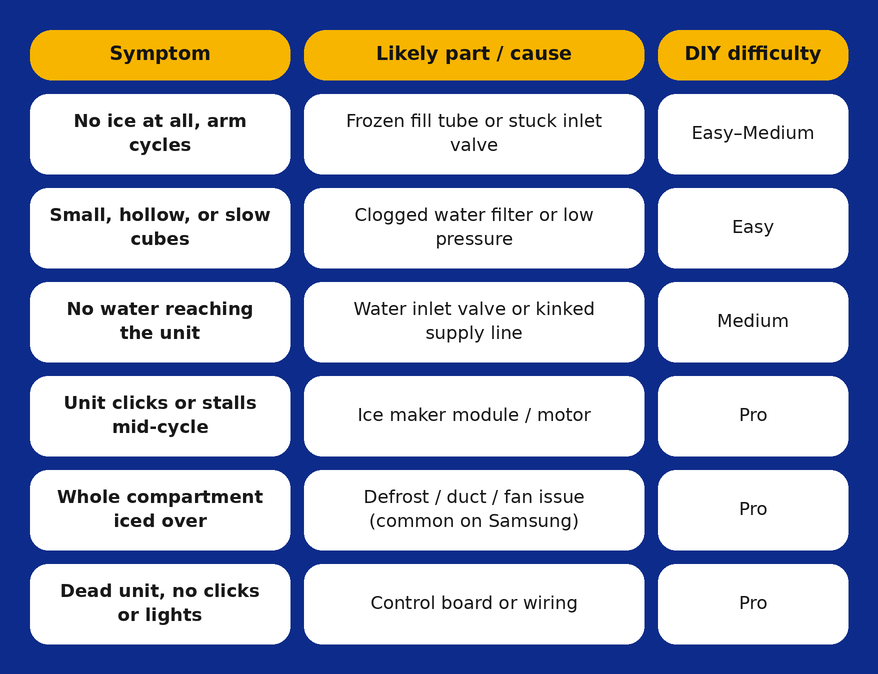
Symptom, likely part, and how hard the fix is
When to call a professional
Some jobs are worth doing yourself. Others cost you more in wasted parts than a service call would. Bring in a technician when water isn't reaching the unit and the filter and line check out, when the module motor is stalling, when the whole compartment keeps freezing over, or when the unit is completely dead. These involve electrical testing, sealed-system defrost work, or board-level diagnosis that's tough to do by trial and error — the kind of work our refrigerator repair team in Charlotte handles every day.
At FM Appliance Service, refrigerator and ice maker repairs are something we handle regularly from diagnosing cooling issues to same-day fixes that save customers from an unnecessary replacement. Our technician Frank has repaired everything from full cooling failures to ice makers that simply stopped producing, often completing the job in a single visit.
How to keep it from happening again
A little maintenance goes a long way, especially with our water. Change the filter every six months. Keep the freezer between 0 and 5°F and don't overpack it — airflow matters. Vacuum the condenser coils twice a year so the freezer can actually hold temperature. Once or twice a year, empty the ice bin completely and let it refill, which clears old, clumped ice and keeps the sensor reading clean. For a full seasonal routine, see our home appliance maintenance tips.
Frequently asked questions
Why did my ice maker suddenly stop working?
A sudden stop is most often a frozen fill tube, a filter that finally clogged, or the freezer drifting too warm to complete a harvest cycle. Check the freezer temperature first, then look for an ice plug at the back of the unit. If water still reaches the dispenser but not the ice maker, suspect the fill tube.
How do I reset my refrigerator's ice maker?
Most units reset by turning the ice maker off and back on, or by pressing a test/reset button on the unit head, then giving it a full cycle to refill. The exact steps vary by brand and model, so check your manual. If a reset works but the problem returns within a day, a part is failing underneath.
Can hard water in Charlotte damage my ice maker?
Yes. Charlotte's moderately hard water leaves scale that clogs water filters and can stick the inlet valve over time. That's why cubes get small or slow here if the filter is overdue. Changing the filter every six months and having scale buildup checked keeps the system flowing and extends the life of the valve.
Is it worth repairing an ice maker or should I replace the fridge?
Repairing the ice maker is almost always the smarter call. An ice maker assembly or inlet valve is a fraction of the cost of a new refrigerator, and the rest of the fridge is usually fine. Replacement only makes sense if the appliance is very old and having multiple unrelated failures at once.
Do you offer ice maker repair in Charlotte and nearby towns?
Yes. FM Appliances provides ice maker repair in Charlotte and across Matthews, Concord, Huntersville, Davidson, Cornelius, Pineville, Indian Trail, Waxhaw, and Fort Mill and Rock Hill in South Carolina. We diagnose the exact cause on site and carry common parts, so many repairs are finished in a single same-day visit.

