


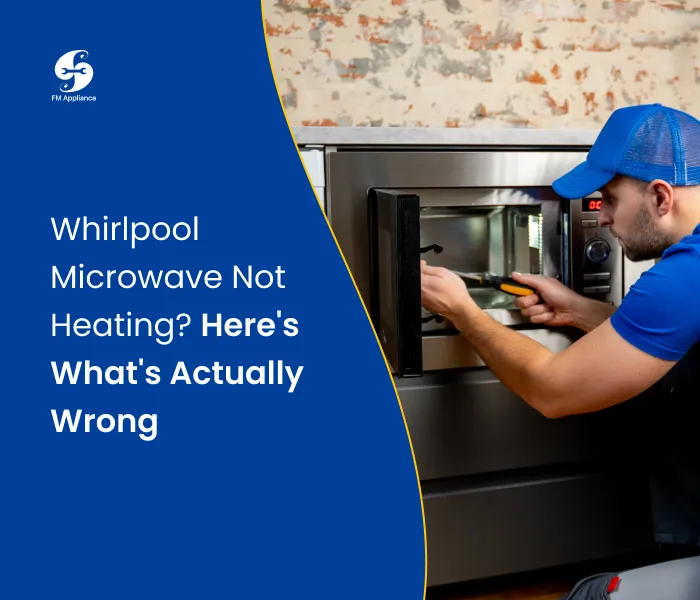
Whirlpool Microwave Not Heating? Here's What's Actually Wrong
Your Whirlpool microwave turns on. The light works. The turntable spins. The timer counts down. But when it beeps — your food is still cold. A microwave that won't heat is one of the most disorienting appliance problems, precisely because everything looks fine on the outside.
The issue is almost always internal, and it's usually one of a handful of components. This guide helps you figure out which one before spending anything.
Start With the Simple Stuff: Settings First
Before assuming something is broken, rule out a settings issue. These account for more "not heating" calls than most people expect.
Demo Mode. This is the most common settings trap. In Demo Mode, the microwave runs normally — light, turntable, fan, timer but the magnetron doesn't activate. It's designed for store displays and accidentally gets switched on at home. To exit: press and hold "1" and "0" simultaneously for 3 seconds, or hold Stop/Cancel + Start together. Look for a "d" or "Demo" indicator on the display.
Control Lock. If you see "LOC" or a padlock icon, the controls are locked. Press and hold the Control Lock button for 3 seconds to release.
Power Level set too low. A power level of 10–20% produces almost no noticeable heat on most foods. Press Power Level and make sure it's set to 10 (full power) before running another test.
Quick test: Fill a cup with cold water, run it for 60 seconds at full power. Hot water means it's working fine. Lukewarm means partial failure. Stone cold means complete heating failure. This tells you immediately whether it's a settings issue or a hardware problem.
What's Really Happening Inside a Dead Heating Circuit
If the water test confirms a real heating failure, the problem is inside the high-voltage circuit. Here's what that means in plain English.
Your microwave heats food using a component called the magnetron — it converts electrical energy into the microwave radiation that excites water molecules in your food. To power the magnetron, a high-voltage circuit involving a transformer, capacitor, and diode works together to supply over 4,000 volts. A failure anywhere in that chain causes the microwave to run normally in every other way but produce zero heat.
Blown Thermal Fuse
The thermal fuse is a one-time safety device that cuts power to prevent overheating. When it blows, the microwave either stops entirely or loses heating depending on the model. The most common reason it blows is inadequate ventilation: the microwave is pushed too close to a wall or cabinet, heat has nowhere to go, and the fuse trips.
Important: If you replace the thermal fuse without fixing the ventilation issue, it will blow again within weeks.
Technician tip: Always identify why the thermal fuse blew before replacing it. Nine times out of ten it's a clearance issue. Check that your over-the-range or countertop microwave has adequate space around it — at least 3 inches on the sides and top for most models.
Faulty Door Switch
Whirlpool microwaves have three door switches that work together as a safety system — the microwave won't start (or heat) if any one of them fails. The door switches verify that the door is fully closed before allowing the magnetron to activate. A failed switch can make the microwave appear to run normally while silently blocking all heating.
Signs of a door switch issue: the microwave runs but doesn't heat, or the interior light stays on when the door is open when it shouldn't.
High-Voltage Diode Failure
The diode converts AC power to DC and doubles the voltage to power the magnetron. When it fails, the magnetron doesn't receive enough power to generate heat. A failed diode sometimes makes a loud buzzing or humming sound during operation — a sound clearly different from the normal microwave hum.
This part is inexpensive but requires safely discharging the capacitor before testing, which stores a dangerous charge even when the microwave is unplugged.
Defective Capacitor
The capacitor works alongside the diode to store and deliver high voltage to the magnetron. A failed capacitor cuts off power to the magnetron entirely. This is the most dangerous component to test or handle yourself — capacitors in microwaves store lethal charges of 2,100 volts or more, even after the unit is unplugged. Do not touch the capacitor terminals without properly discharging it first using insulated tools.
Magnetron Failure
The magnetron itself is the component that actually generates heat. When it fails, the microwave runs completely normally — all sounds, all functions — but produces no heat whatsoever. Magnetron failure sometimes comes with a burning smell or a buzzing sound during the cycle.
On countertop microwaves, magnetron replacement often isn't economically worth it — the part plus labor can approach or exceed the cost of a new unit. On built-in or over-the-range models, which are significantly more expensive to replace, magnetron repair makes much more financial sense.
Control Board Fault
The control board is the brain of the microwave. If it malfunctions, it may stop sending signals to the magnetron even though everything else appears to work. Look for burnt components, visible damage, or the F1E6 error code on Whirlpool models — this code specifically indicates a detected magnetron or inverter board failure. A chattering or clicking noise during operation can also point to a control board issue.
Diagnostic Table: Match Your Symptom
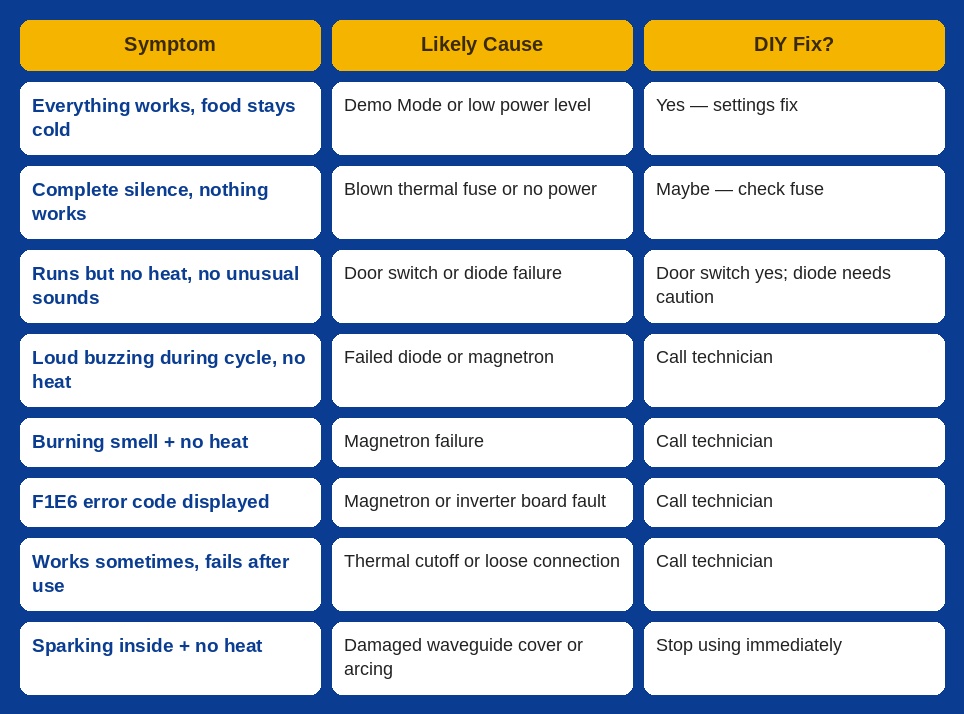
A Safety Note Before You Open Anything
Microwaves are among the most dangerous home appliances to open more so than most people realize. The capacitor stores a charge of over 2,000 volts and retains that charge even when the unit is completely unplugged. Contact with a charged capacitor can be fatal. Even experienced technicians discharge capacitors before touching anything nearby.
If your troubleshooting goes beyond checking settings and looking for visible damage, call a professional. The door switches are relatively safe to inspect; everything involving the high-voltage circuit is not.
Getting Help in Charlotte, NC
If the water test confirms a heating failure, or you're seeing the F1E6 code, sparking, or a burning smell, our appliance repair team in Charlotte, NC handles Whirlpool microwave diagnostics and repair across the metro, including Cornelius and Davidson. We also service the full range of microwave brands, from over-the-range to countertop units. For other Whirlpool appliance issues in your home, our washer repair team covers the full range.
A microwave that runs but doesn't heat almost always comes down to one specific component, and most of them aren't safe to diagnose or replace without training. Schedule a diagnostic visit today and get it fixed the right way.
Whirlpool microwave running but not heating? Our appliance repair technicians in Charlotte, NC diagnose and repair Whirlpool microwaves across the metro, including Cornelius and Davidson. Schedule your visit today.
Frequently Asked Questions
Why is my Whirlpool microwave not heating but running normally?
The most likely causes are a failed high-voltage diode, blown thermal fuse, faulty door switch, or magnetron failure. The microwave's control systems continue working independently of the heating circuit, so everything can appear normal while the heating component is completely dead.
My Whirlpool microwave shows the F1E6 error code what does that mean?
The F1E6 code on Whirlpool microwaves indicates a detected failure in the magnetron or inverter board. Don't attempt to diagnose or repair this yourself it involves high-voltage components. Call a technician.
Is it safe to keep using a Whirlpool microwave that's not heating?
Better not to. If the cause is a damaged waveguide cover or internal arcing, continued use can cause further damage or create a fire hazard. Unplug it until it's been inspected.
Can I fix a Whirlpool microwave not heating myself?
Settings issues, Demo Mode, and door switch replacement are reasonable DIY tasks. Anything involving the capacitor, diode, or magnetron shouldn't be the capacitor holds a lethal charge even after unplugging. These components require a trained technician with proper discharge equipment.

