


Bosch Dryer Showing E01? Here's What It Means and How to Fix It Fast
Your Bosch dryer stopped mid-cycle and E01 is blinking on the display. Before you assume the worst, here's the good news: E01 almost never means the dryer itself is broken. It means the dryer is detecting a problem it can't push past and in nearly every case, that problem is airflow. Unlike an electronics fault or a failed heating element, this is one of the more fixable codes a Bosch dryer can throw, and in most cases, you can clear it yourself in under 30 minutes without calling anyone.
What Does the Bosch Dryer E01 Code Actually Mean?
The E01 error on a Bosch dryer signals a blockage in the lint filter area or airflow path, which prevents the heating element from working the way it's supposed to. Instead of letting the dryer keep running hot air into a system that can't move it out, the control board stops the cycle. It's a built-in safeguard, not a malfunction — the dryer is telling you exactly where to look.
Bosch dryers, like most modern appliances, rely on sensors throughout the airflow path to monitor how efficiently air is moving from the drum, through the lint filter, and out through the exhaust system. When resistance builds up anywhere along that path, the sensor readings shift outside the expected range, and the control board responds by halting the cycle rather than continuing to run hot air through a restricted system. That's a deliberate design choice, not a flaw — it exists specifically to catch airflow problems before they turn into something worse.
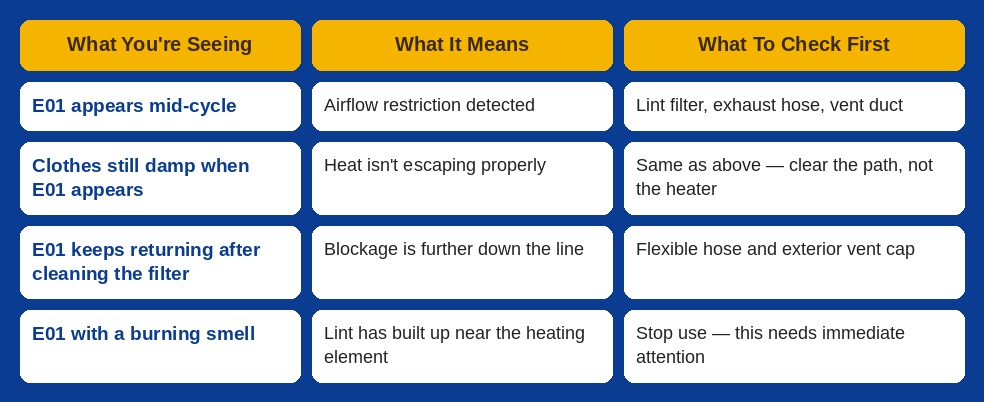
E01 at a Glance
Why Your Bosch Dryer Throws This Code in the First Place
E01 isn't random, and it isn't a sign you did something wrong. It's the direct result of air not moving through the system the way the dryer expects. A few things typically cause it, roughly in order of how often they actually turn out to be the culprit:
A clogged lint filter. This is the single most common cause, and the easiest to fix. Lint builds a fine film over the mesh that isn't always obvious just by looking — running it under warm water occasionally clears buildup a quick wipe misses. If you've never rinsed your lint filter and only ever wiped it by hand, this is worth doing before anything else.
A blocked or kinked exhaust hose. The flexible hose connecting the back of the dryer to the wall vent collects lint over time and can get crushed if the dryer sits too close to the wall. This is especially common after a dryer has been moved for any reason — a repair visit, a flooring replacement, or even just sliding it out to sweep behind it — and not pushed back with enough clearance afterward.
A restricted exterior vent. Outside your home, the vent cap has a flap that's supposed to open freely while the dryer runs. Lint, debris, or nesting material can jam it, which restricts airflow even if everything inside the house is clean. This cause is easy to overlook because it's the one part of the system most homeowners never actually look at.
A vent run that's too long. Every manufacturer sets a maximum duct length, and it gets shorter with every 90-degree bend. If your dryer sits far from an exterior wall, the vent system may be borderline even when clean — meaning E01 can show up periodically even with regular maintenance, simply because the installation itself is close to the airflow limit.
Lint accumulation deep inside the duct run. Beyond what a homeowner can typically reach, lint can build up over years inside the portion of duct that runs through a wall, floor, or ceiling. This is usually the explanation when E01 keeps returning despite every accessible part of the system checking out clean.
How to Fix the Bosch Dryer E01 Error — Step by Step
Step 1: Clean the lint filter completely. Remove it and clean it by hand, then rinse it under warm water if you notice any waxy residue (usually from fabric softener sheets). Let it dry fully before putting it back in — reinstalling it while still damp can cause lint to stick even more aggressively next cycle.
Step 2: Pull the dryer out and check the exhaust hose. Disconnect it from the dryer and the wall. Look for crushed sections, sharp bends, or visible lint clumps. Clear what you can reach and straighten any kinks before reconnecting. If the hose itself looks old, brittle, or is made of foil/plastic accordion material, this is a good time to consider replacing it with rigid metal duct.
Step 3: Check the exterior vent cap. Go outside, find the vent hood, and open the flap by hand. Clear out any lint, debris, or nesting material, and confirm the flap swings freely and doesn't stick. In spring and early summer, check specifically for signs of birds nesting — this is one of the most common exterior blockages homeowners encounter.
Step 4: Run a short test cycle. Reconnect everything and run the dryer for 15–20 minutes. If E01 doesn't return and the airflow feels stronger at the exterior vent, you've cleared the blockage. As a quick confirmation, hold a tissue near the exterior vent while the dryer runs — it should be pulled firmly outward, not fluttering weakly.
Step 5: Call in a professional if E01 keeps coming back. A returning code after you've cleaned everything accessible usually means the blockage is deeper in the duct — often inside a wall or ceiling — which needs a proper rotary brush cleaning rather than a store-bought kit. Store-bought brushes typically only reach the first few feet of duct, so if your installation has any length to it, a DIY attempt may only clear part of the problem.
E01 Won't Go Away? Here's What Else It Could Be
If you've worked through every step above and E01 still shows up, a few less common causes are worth ruling out:
The vent duct is too long or has too many bends for the model's spec — airflow will stay restricted no matter how clean the duct is until the run is shortened or a booster fan is added
The duct material itself is the problem — flexible plastic or foil accordion duct traps lint far more aggressively than rigid metal and should be replaced regardless of the code
A sensor is misreading airflow — rare, but possible if a professional confirms the vent system is genuinely clear and the code persists anyway
The dryer is significantly overloaded on a regular basis — pushing too large a load through the drum repeatedly can strain airflow even in a well-maintained vent system, since the dryer has to work harder to circulate air through a tightly packed drum
If a technician has confirmed the vent system is completely clear, correctly sized, and the code still appears, that's the point where the issue shifts from a maintenance question to a genuine component diagnosis — worth having a professional look at rather than continuing to guess.
Don't Ignore This Code Here's Why
A blocked airflow path isn't just an inconvenience that makes laundry take longer. Lint is highly flammable, and a restricted vent traps heat in the same space where lint is accumulating — the exact combination behind most home dryer fires. Bosch's E01 code exists to stop that from happening before it becomes dangerous. Clearing the blockage the first time it appears is a lot easier than dealing with the alternative, and it's also worth remembering that a dryer working against restricted airflow runs hotter and longer than it should — which adds wear to the heating element and motor over time even if it never triggers a safety concern.
How to Keep E01 From Coming Back
Once you've cleared the blockage, a few habits go a long way toward keeping the code from reappearing:
Clean the lint filter after every load, not just when you remember to
Clean the full vent duct run once a year, or twice a year for heavy laundry use or homes with pets
Keep at least 4–6 inches of clearance between the dryer and the wall so the exhaust hose can't get crushed
Check the exterior vent cap seasonally, especially in spring
Avoid consistently overloading the drum, even for large items like comforters
Getting Help in Charlotte, NC
If you've gone through every step and E01 is still showing up, our appliance repair team in Charlotte, NC handles dryer vent diagnostics and washer and dryer repair across the metro, including Cornelius and Davidson. For a broader look at vent-related warning signs across all dryer brands, see our guide on dryer vent cleaning.
An E01 code that won't clear is worth getting looked at properly rather than guessing at further fixes. Schedule a diagnostic visit today and get your dryer back to running the way it should.
Bosch dryer stuck on E01? Our appliance repair technicians in Charlotte, NC handle Bosch dryer diagnostics and vent cleaning across the metro, including Cornelius and Davidson. Schedule your visit today.
Frequently Asked Questions
Is it safe to keep using my Bosch dryer if it shows E01?
Not recommended. The code appears because airflow is restricted, and running the dryer through a blockage increases heat buildup near the lint. Clear the issue before running another full cycle.
I cleaned the lint filter but E01 still appears — why?
The lint filter only catches a portion of the lint your dryer produces. If E01 persists after cleaning it, the blockage is likely in the exhaust hose or exterior vent, not the filter itself.
How is E01 different from other Bosch dryer error codes?
E01 specifically points to an airflow or lint blockage issue, which is one of the most common and most fixable Bosch dryer codes. Other codes, like those related to the control board or heating circuit, point to internal component issues rather than a vent problem.
How often should I clean my dryer vent to prevent E01?
Once a year is generally enough for average use. Households doing laundry daily, with pets that shed, or drying bulky items often should clean the full vent run twice a year.
Can a crushed exhaust hose really trigger E01 on its own?
Yes. Even a partial crush from the dryer being pushed too close to the wall is enough to restrict airflow and trigger the code, even if the lint filter and rest of the vent are completely clean.
Does overloading the dryer make E01 more likely?
Yes, indirectly. A drum packed too full restricts how freely air can circulate through the load itself, which adds to whatever resistance already exists in the vent system. It's rarely the sole cause, but it can be enough to tip a borderline vent system into triggering the code.

